Steven Spielberg’s Close Encounters with the Third Kind (1977) is a film about unidentified spacecrafts making an appearance on Earth, but instead of a suspense-filled invasion like most alien movies, it’s more mysterious and alluring. Although the movie does have its thrills, the reaction of the audience is more often wonder, shock, or awe rather than fright. The way that the scientists in the movie learn to communicate with the extraterrestrials is with music: a five-note melody that was broadcasted as radio frequencies into space and directly to the aliens with a massive speaker system at the end of the movie.
When discussing music in this film, the most obvious subject would be the way this very melody is used. The solfege syllables are transcribed directly in the text of the film: re-me-doe-(octave) doe-so. This very simple, diatonic melody can be heard in numerous places throughout the film, both diegetic and not. For instance, the young boy Barry plays the tune on his toy xylophone, and it is used prominently as a theme in the movie’s score. Especially noticeable at the end of the movie when the mothership is flying away, the melody is nearly impossible to miss in the strings. However, the spaceship played much more than this melody in response to the humans. For the “third kind’s” grandest statement, or perhaps teaching the humans their language, the ship starts by playing rapid variations of the theme with an instrument that sounds (suspiciously) like a tuba, and some responses that are almost like a flute or oboe. This “performance” was almost fugue-like, and ends up incorporating many more instruments that resemble other brass and woodwind instruments. Despite being very chromatic, it seems to follow conventions of what oddly resembles Western classical music.
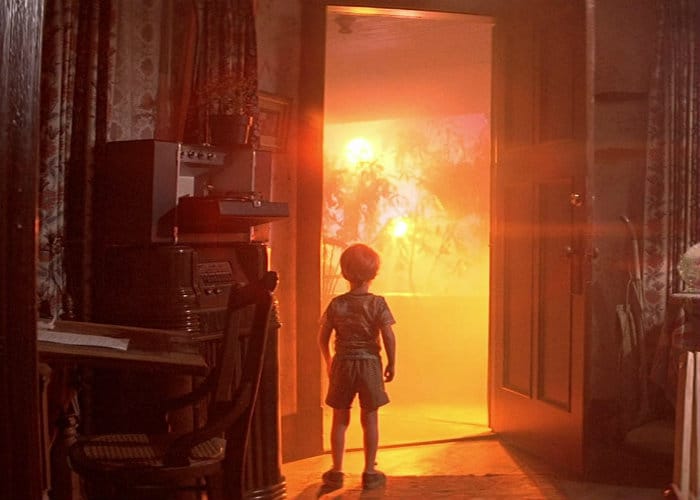
A scene that really struck me, although didn’t feature much music, was about 15 minutes into the film when Barry first encounters the extraterrestrials in his house. After all the sounds of the bleeps and running motors of his toys which are coming alive, he walks downstairs and there is the sound of something wandering the house. Footsteps, things falling over, and doors opening are all heard while the camera stubbornly shows only a medium shot of Barry’s reaction. By obscuring what is making those noises, the viewer is left only to wonder, which heightens the viewers’ interest and creates a dramatic tension between the character and the fourth wall. Furthermore, it is symbolic of the fact that throughout the movie Barry seemingly knows more about who or what they are than any of the other characters in the film. He knows things that the others don’t and that is demonstrated in this scene where we are given only his reaction to the events that are unfolding in his house.
In all honesty, it’s hard to pick only a couple moments of this film to discuss in regards to the sound and music. John Williams definitely leaves an impression with his ability to compose memorable themes and highlight the curiosity and wonder that films have the ability to cast on a viewer. Before this film, my mind typically went to Star Wars or Indiana Jones when I thought about John Williams’ music, however now I can see that Close Encounters is overlooked. Beyond just the music, all the sound work in the movie is nothing short of incredible and truly leaves the viewer with a bigger-than-life sense or wonder.
 ben_making_sounds
The conversation between the aliens and the humans in the stadium stood out to me too.
LikeLike
Great post, Ben. Great observation about the camera angle choices made with Barry–what is so unsettling is that he is totally unperturbed and unthreatened by the aliens, and while this should make the audience relax, it only makes the dissonance more disturbing. I agree–this is an overlooked score, with a pretty wide variety of music cues.
LikeLike