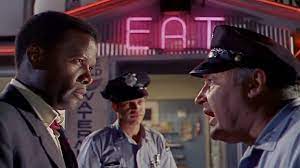
Norman Jewison’s In the Heat of the Night (1967) is a mystery drama that unravels a gripping murder case while candidly dealing with topical racial and social issues in America. The story takes place in the small town of Sparta, Mississippi which had plans for a prosperous factory to be built until the owner was found dead from a homicide. What was originally assumed by the local police to be a simple robbery-murder case was found to be the result of racial tension by Virgil Tibbs, an African-American Philadelphia homicide expert who happened to be passing through the town at the time of the murder. The film highlights racial bias in day-to-day life and in the judicial system, and how deep-rooted biases affect our assumptions.
The main theme by Quincy Jones has lots to be enjoyed: a gospel arrangement sung by Ray Charles with a memorable refrain that sets up the rest of the movie. However, it is the more subtle ways that the theme is used later in the movie that interested me most. At around 58 minutes into the film Virgil is inspecting Colbert’s car and finds a couple of clues that lead him to believe that Colbert died in his vehicle. While doing so, there is the recurring wood block that is heard whenever Virgil seems to be suspecting something or connecting some dots. On top of that is the excellent flute work. It incorporates fluttertounge and is possibly improvised, adding some curiosity and mystery to the sparse texture. When he holds up the twig from the cotton fern there is a subtle variation of the main theme in some reed instruments, possibly clarinet and saxophone. This lets the viewer know that Virgil just figured something out.
Beyond the music, the soundwork when there’s wasn’t any score really had an impression on me. There was a very intentional use of ambient effects such as crickets which actually amplify the quiet or the squeaking of Gillespie’s air conditioner that tells the viewer how hot it is during the night. A scene that stood out with its lack of music was the chase sequence about 26 minutes into the film where the police are pursuing Harvey. Where one might expect intense music in this chase scene, there is instead only the sound of rustling leaves, dogs barking, and heavy breathing. The choice to omit music from this sequence actually adds emphasis to these sounds and creates immersion for the viewer.
Overall, the movie was very refreshing to me in its approach to sound and music. The music the movie used featured really unique textures that weren’t the typical orchestral themes and the ambient sounds really helped suspend the viewers’ disbelief that they were in the hot, southern town of Sparta, Mississippi.
 ben_making_sounds
I like that you noticed the sound of the woodblock during Virgil’s examining of Colbert’s car. I also noticed this sound but couldn’t figure out what it meant. Your reasoning for the sound makes sense!
LikeLike
Nice post, Ben. Good observations on those musical details–I also really like the use of jazz flute in this score, along with the subtle use of percussion and that great tack piano. I think what’s interesting about the film is that in the end, the crime that generates the story is maybe less about race that it is about a good old-fashioned robbery that gets someone out of a jam…but of course, the crime doesn’t matter much in this film, it’s really about assumptions, prejudice and relationships. I agree that the score is refreshingly sparse and effective because of it.
LikeLike