This week I added a couple sounds to my sound bank, created a new etude, and was working on a side project of my own, but I am happy to say that these three things are held strung together by the same line: I’ve begun work on incorporating my Gameboy Advance (GBA) into my composition (or at least, I’ve taken the first steps).
Composing on Gameboys is something that I have been doing research on for some time now. I’ve already been composing for 5-channel Nintendo Entertainment System (NES) with digital trackers, which is essentially software that allows me to emulate the effect of writing and playing back music on a true 80’s NES. I was unsatisfied, however, I wanted to look into writing for Gameboys, which is similar, and after all, I own two GBA’s that have been doing nothing but collecting dust for years at home. Although most Gameboy artists prefer doing work on older systems such as Dot-Matrix Gameboy (DMG) or a Gameboy Color (GBC), these are hard to come by and thanks to Nintendo’s convenient cross-platform compatibility, most software won’t be a problem using on my newer GBA.
This did require, however, dishing out some money and ordering some items online. A couple things came in the mail this weekend from Catskull Electronics, earlier than expected: the teensyboy, a link cable for the GBA, and two basic Gameboy 32k cartridges- mGB and Shitwave. The Teensyboy is a tiny (teensy) device with a mini-USB jack on one end and a Gameboy link port on the other that is used to allow MIDI data to be sent and received from the Gameboy to a controller or DAW or your liking. The mGB cartridge is used to with the Teensyboy to make it work, and Shitwave is just a neat little novelty ROM that I picked up for drone/noise stuff (and it makes your Gameboy seem broken). The teensyboy is where I started having issues. I wanted to to plug my MIDI keyboard directly into the device, but my keyboard has a USB type A output and the teensyboy has a mini-USB. I don’t have such a chord; no one does. This ended up being beyond frustrating. I looked into a female to female USB adapter, which you can find for very cheap online. However, my impatience got the best of me and I decided on the rational option of cutting open the two USB cables I needed and combined the heads (USB-A and mini-USB). I did this professionally by twisting the wires together, wrapping them in electrical tape, and hoping they wouldn’t come apart.
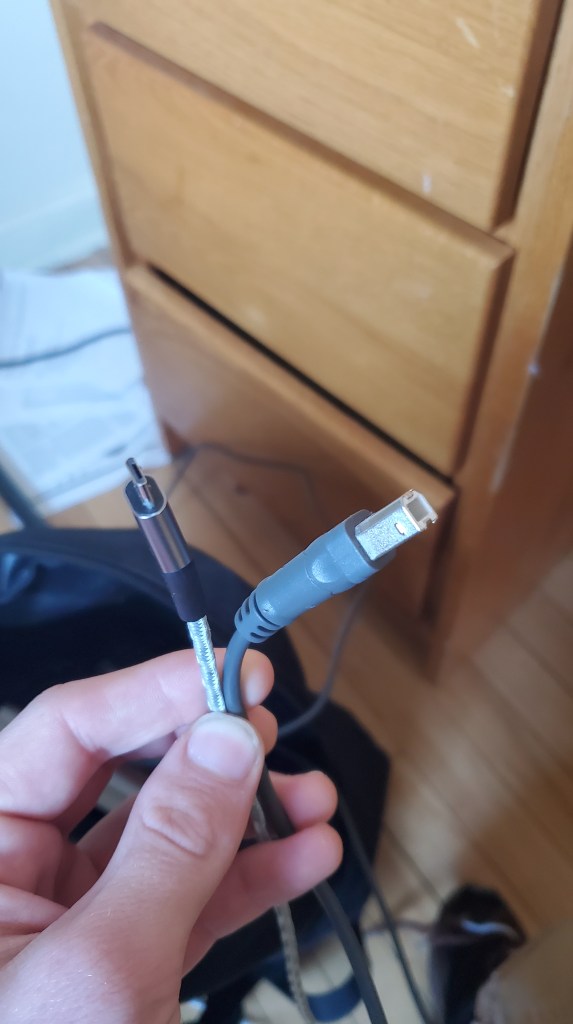
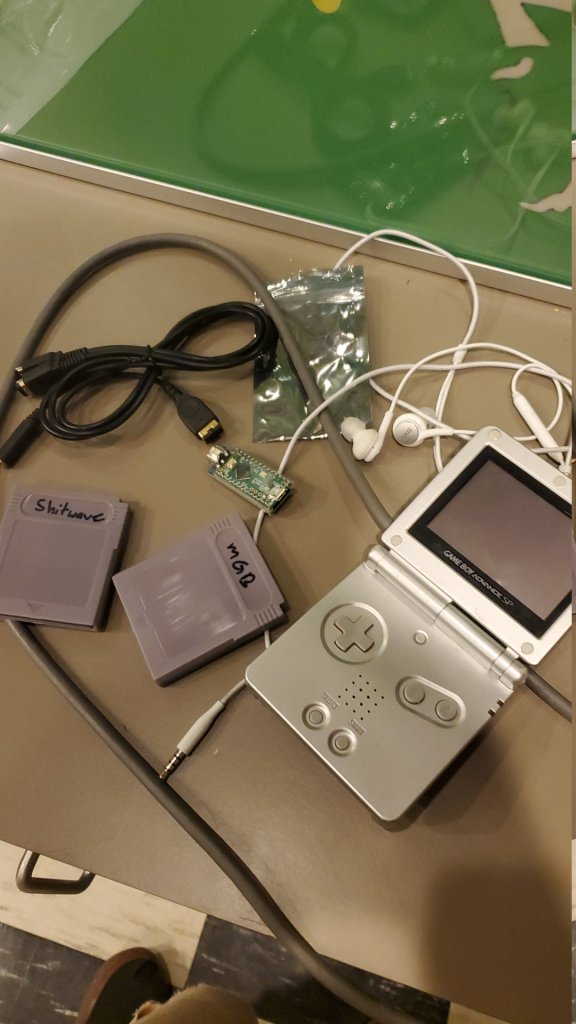
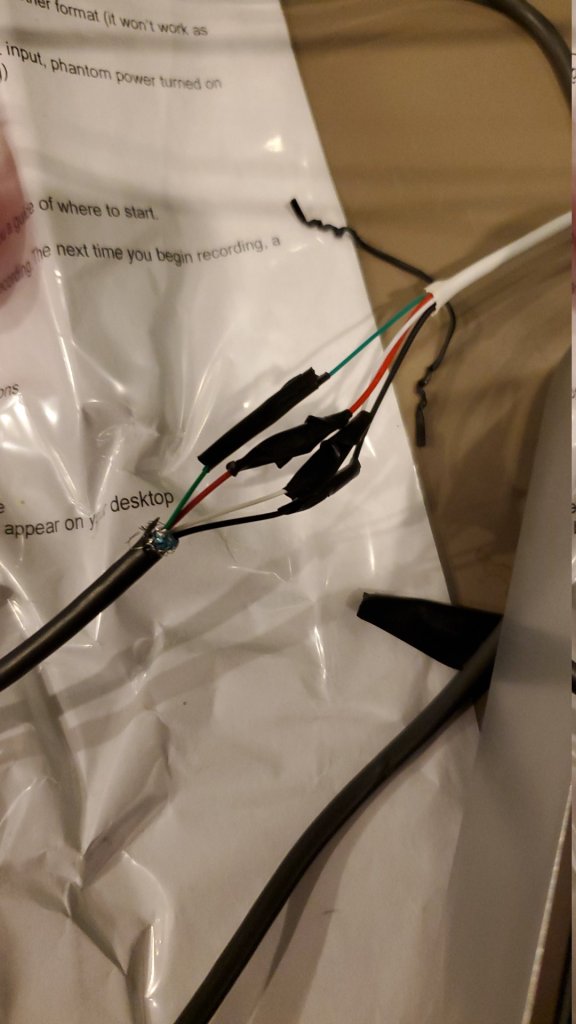
This actually almost worked, as in the teensyboy reacted and acknowledged it was receiving power. However, despite all my efforts, I was not able to actually get the MIDI data to find its way to the GBA to produce any sound. The only way I was able to get mGB to work was by plugging it into the computer and sending MIDI from Reaper. This is helpful though: this way I can actually compose entire songs via MIDI and have it played directly on the Gameboy without much issue. However, I’d like to take any DAWs out of the picture, if possible. I am still working on this.
For the assignment I used much more basic approaches to composing with the Gameboy. I recorded couple different start-up sounds as well as a couple drones from Shitwave. I ended up using the default GBA start-up sound for the entirety of my etude. The start-up sound is a gesture that consists of two distinct tones: a lower strummed chord followed by a higher pitched “bling” sound. I also incorporated the sound of me physically turning the power switch on and off. Equalization (high bandpass filter), looping, and panning allowed me to create a twinkly texture that floated in the etude, and this was contrasted by punchy cuts of the switch. The etude concludes with a deep, droning texture of the opening chord, time-stretched and looped until it fades away. Although I would prefer to use my own DAWs such as FL Studio or Audacity, I’m having little to no trouble figuring out Reaper and composing this short etudes.
 ben_making_sounds
Hi Ben,
Good to hear you’re making progress on your Gameboy project! I’m looking forward to hearing what you come up with!
LikeLike
Good for you for documenting all this, Ben! You’ll appreciate having this log as you continue to work on this project.
LikeLike