Composition Blog #4

It’s that time of the week! This week in composition has been extremely busy for me and has mostly consisted of me constantly trying to get stuff done to make time for me to compose, but constantly getting stuck with more and more things to do. That doesn’t mean that I didn’t taste any progress at all, and I still have to find some takeaways from this week.

First of all, what I did do. The time I did get to spend with my music was mostly improvising some electronics with my new Gameboy setup. I’ve effectively assigned every interesting parameter on mGB with values on my MIDI keyboard, giving me almost full control of the device without touching it. This helps a lot with composing and makes the workflow faster. I started by writing literally one, droning note with some automated phase modulation on the Gameboy, and just sort of “jammed” over it. I was actually quite shocked at how much raw noise I was able to get out of just the two Gameboys alone, one running mGB and the other droning the glitchy Shitwave. I now have a fairly good basis on what I want to do for my composition and how.

I’ve also done a little bit of recording, but not exactly what I wanted to get. I already got a short sound clip of a buzz-saw that I want to use for my project from the scene shop in the CFA, but I wanted to go a little further and see what the workers under the painting studio by Facilities would have for me. However, I struggled to find a time where they were working and I was free in my busy schedule. The one time I did manage to go, I couldn’t find anybody. However, there were some grounds workers just across the street that were happy to give me some of the abrasive sounds I was looking for. One of the sounds includes spraying the back of a pick-up truck with a water hose, and I was amazed at just how assaulting that ended up sounding. Hopefully I can still make a trip to the scene shop for some industrial noises, but I am looking forward to what I can do with what I’ve got.

Anyway, moving forward I think I’ve learned that I have to make time for composing, if it’s something I truly want. There’s always more “other things” I could do, and I think a lot of that comes from a lack of respect for myself and what I do. I don’t see composing and writing new material as “important” as other work I may have to do, or as a good enough excuse to put something else aside. And although balancing all my time is important, that balance requires a serious assessment of priorities. Especially when it comes to composing, finding time doesn’t just show up. Hopefully next blog will have some real output I can share, the deadline is creeping up quickly.
Listening Blog #3

This week’s study was of Dhomont’s Forêt profonde and a reading from Francisco Lopez “Blind Listening”.

The CD for Foret profonde that I listened to was split into 13 different tracks. Unlike some of the previous pieces, this one had a much more abstract or elusive context. For example, the previous listening, El Tren Fantasma, was sounds recorded from a train, and the piece was very clear about its own conception. This is also explicitly true for I am sitting in a room. Foret profonde, however, does not have such a clear connection to “real world sounds” or settings, and has a similar abstraction that a piece of instrumental music may have, for example.

This is not to say that all the sounds are not recognizable to their sources: soundscapes of wilderness, frogs, crickets, cars, and even familiar instruments like pianos can be heard throughout. An especially notable recurring sound that Dhomont uses is human speech. Several tracks on the album feature some kind of recording of spoken word, usually in French- ranging from being referenced to being overwhelmingly prominent. However, I would argue that the voices still are not really meant to be listened to and comprehended in the sense that they need to be understood, but are rather just meant to be heard in a sonic sense. Dhomont emphasizes the unique timbre that speech has, and how enthralling the voice can be. The second track on the CD, “Á l’orée du conte”, is an great example of this element. The first voice that is introduced is deconstructed with some kind of gate effect: almost as if it has been physically compressed. The result, to say the least, is disturbing. I do not speak French, but I believe it would be nearly incomprehensible even if I did (assuming the voice was in French, that is). Here, Dhomont is taking away emphasis on the actual meanings of the words but rather the sounds the words produce. Later in the piece, more clearly spoken voices start stacking onto each other from different locations in the sonic space. For me, this made the space very anxious and almost overwhelming. Again, I do not speak French so it is hard for me to make a fair assessment, but I believe that the voices are too chaotic to be possibly all understood, or at least, not at once. In this way, I think Dhomont is challenging our tendency to listen to the words spoken by the voice, but to listen to the unique timbre it contains, which may often be overlooked. I think, in this way, it may not be so different from what Lucier was trying to achieve with I am sitting in a room, where the words of his voice were deconstructed to the raw, unique timbres that they produce. Lucier would be an extreme example, however.

I find this to connect very appropriately to the reading from Lopez. Lopez makes a case for what he calls “blind listenings”, which is essentially the practice of listening to sounds totally divorced from their “real-world” contexts that we may naturally associate them to. This spoke well with me: I think people have a tendency to dismiss field recordings as just empirical documentation rather than a tool to present untold stories and feelings. In relation to Foret profonde, Dhomont is altering and combining sonic settings in ways that are unrecognizable. Even the artwork featured on the CD is a confusing collage of a city skyline and a sketch of a jungle. This approach forces the listener to engage with the music formally. Indeed, Francisco Lopez comes across to me as a formalist: he believes that good art can exist and only should exist outside of the context of it’s setting and/or author, and bears a universal quality that is present on its own.

Composition Blog #3

This week I worked on some projects for the class as well as continuing work on my personal Gameboy project, which hopefully, will find a way to intersect with my composition classwork.

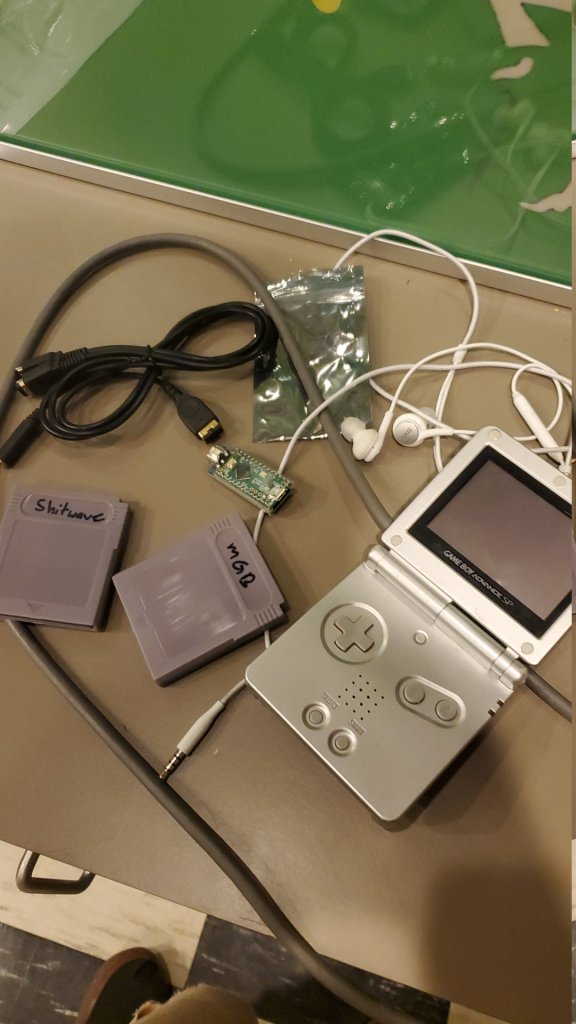
Few major developments have been made with my Gameboy, besides the fact that I got a second working GBA. All it really took was for me to open it up and clean it up a little bit. However, it is fussy. The batteries have to be in just right. I’d like to replace this with some kind of DC input by just splitting open a DC power chord and connecting metal to the positive/negative battery springs on the device. Also, the start and select buttons don’t work at all, which could be critical for certain ROMS. However, it does have a built-in auxiliary port which actually has great stereo output. Another really useful thing I got to work was the auxiliary chord for the GBA SP. The SP doesn’t have a built-in aux out, so it needs a little cable to send audio out of the device. I had one but it didn’t work. Thanks to some help at Luther’s Maker Space I was able to solder on a new female-auxiliary port. Now I have two GBA’s with fully-functional stereo output, and they sound great. I just need a device that control them without using a DAW or a laptop. That’s why my next advancement will be to set up a Raspberry Pi mini-computer to control the Gameboys.

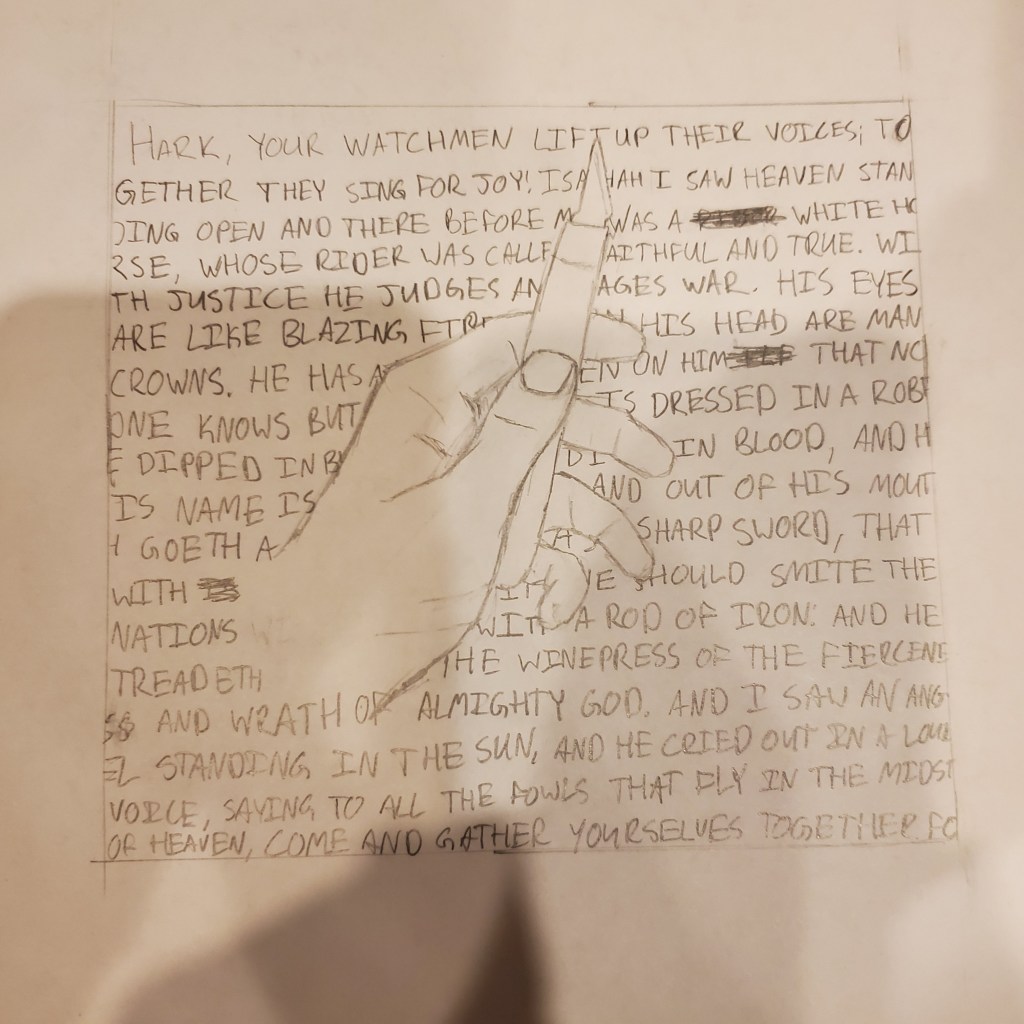
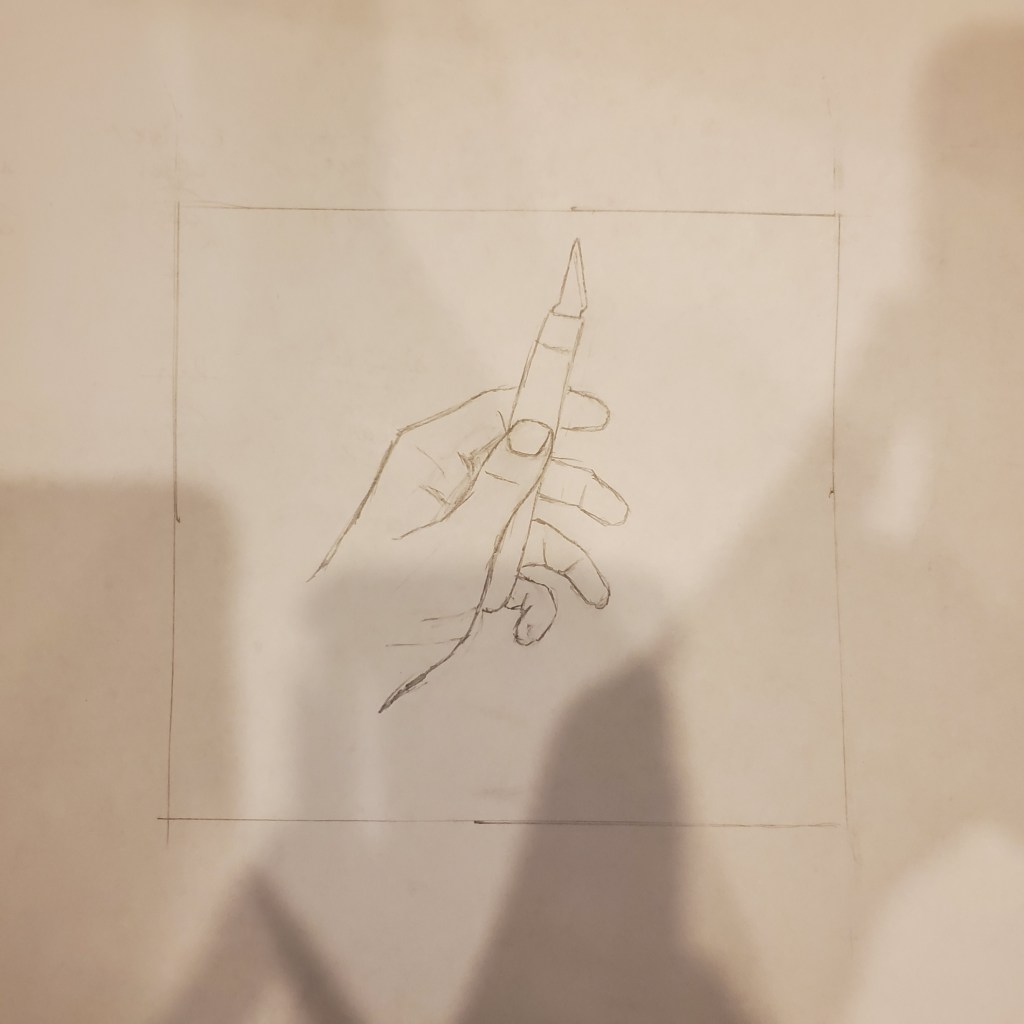
The “composition” assignment this week was to create a visual sketch of what will be our midterm piece. I’m really bad at creating literal connections to narratives or directions in my music, so like most things, I tried approaching it on a more abstract level by focusing on aesthetics. In my score I thought I’d like to have some kind of clear, conceivable MIDI-based lines that slowly becomes drowned and drenched in abrasive noise. I was thinking about the contexts of sounds, and how a clear melody can actually be more recognizable to a listener than a recording of a “real-world” noise, and part of my composition may want to toy with this distinction. I thought the best way to represent this in the visual was by having some image that is physical, clear, and tangible: in this case, the hand holding the scalpel. I best reason I can give for choosing this image was because I have an attraction to sharp, pointy things both physically and sonically. The more accurate answer, however, is probably that I just liked the aesthetic it had. The words that are flooding around the sketch are not really meant to be read, but they are mostly taken from Revelations chapter 19. This, to me, was a good representation of the “noise” that engulfs the object of focus. Furthermore, I am playing with the idea of possibly including some spoken word into my composition, and if I do, it would probably be of some literature with powerful language, such as the text used.

Due to some issues with the audio recorder we use in the studio, I have not yet recorded the sounds that had in mind. I hope to get to them as soon as possible. I want to get some more raw, abrasive sounds. I will take the recorder to the scene shop at Luther and see if I can get some sounds of power tools or something industrial like that. I may also exercise some scream vocals in the whisper room. Stay tuned!

Listening Blog #2: Chris Watson’s “El Tren Fantasma”

Welcome back. In last week’s listening blog I responded to Alvin Lucier and Hildegard Westerkamp, and this week my subject is Chris Watson’s El Tren Fantasma.

Doing (minimal) research after my initial listen of the album revealed to me that Watson is primarily a field recording artist who typically releases his works as raw sounds, but on occasion takes the sounds to the studio for projects with Touch Records. El Tren Fantasma is his fourth studio album with Touch, and consists of sounds from a now defunct rail service across Mexico recorded over two decades ago.

It is important for it to be stated that, although the piece still exists in the musique concrète style of using and manipulating recorded sounds from the real world, the recordings on this project have been heavily edited, stylized, and constructed into a narrative. This is effective at creating a wonderfully coherent piece of music, but the listener is not listening to raw audio files or, in some cases, sounds that I don’t think are even meant to resemble the original source or its context.

The album starts and ends with an announcer or station speaker that announces the arrival of the “ghost train”, and introduces the listener to the setting of the work. She is also heard on the last track to close; probably more in reference to the beginning than anything else, to give a heightened sense of coherency to the album. There is another instance of human speech on the album in track 4, sounding like some kind of caller dialing in to a com line. I guess that these are some the few audio samples that may have not been recorded in the “field”, but were rather scripted in a studio.

The sounds of the trains themselves are haunting, deep, and spacious- like the ghost of an ancient locomotive. Harmonies are sometimes heard from pitches of the train, such as whistles or exhausts. However, the recordings are often submerged, looming bass sounds that are so low they almost lose any discernible pitch. Where the “studio magic” really began to appear to me was during more contemporary moments in the album such as on track 4, “El Divisadero”. A very recognizable, repetitive rhythm emerges around the half-way mark of the track from the sound of the rail. A stereo “ping-pong” delay effect on the rail really emphasizes this groove, and the rhythmic setting is even further pushed when a rather monotone “thump” starts to kick in every 4 beats or so. Sitting above it is a floating harmonic instance that seems to sustain indefinitely. I think this track is a great example of the more “dream-like” energy El Tren Fantasma tries to present to its listener by stylizing the real-world sounds to a more surrealist state.

The sonic setting isn’t only following the moving train. Track 9, for example, seems to lack locomotive recordings entirely. The scene shifts to somewhere outdoors in the wilderness, similar to the images Westerkamp painted in her soundscapes last week. The chirping sounds of the forest or jungle is so present it’s almost deafening. About half-way through this over ten-minute track is yet another peculiar scene change, yet this time far more subtle. The sounds of the wilderness are still loud and clear, but now partially obscured by the sound of what is perhaps a distant road or highway. Something creaking is nearby, such as an old wooden chair or door. At one point, some kind of vehicle seems to fly past, such as a helicopter or airplane. The sound echos throughout the entire area the soundscape creates

The final track closes the album with a much more linear and familiar sound. The sound of the train in this is dreamy but still very present. The noise from the train reverberates and harmonizes with itself to the extent that it almost sounds like some kind of cathedral choir. The audio slowly draws in and out, reflecting the feeling of being in a dream or drifting away.

Overall, I thought the work was very adventurous and succeeded in “taking me on a trip” on El Tren Fantasma. Indeed, the sounds I heard may have not been the true, raw audio files from the train itself. But Watson’s manipulation of the sounds, in my opinion, succeeds at presenting deeper, hidden stories from the locomotive without sacrificing the integrity of the artifact that the empirical audio may not be able to tell on its own.

Composition Blog #2

This week I added a couple sounds to my sound bank, created a new etude, and was working on a side project of my own, but I am happy to say that these three things are held strung together by the same line: I’ve begun work on incorporating my Gameboy Advance (GBA) into my composition (or at least, I’ve taken the first steps).

Composing on Gameboys is something that I have been doing research on for some time now. I’ve already been composing for 5-channel Nintendo Entertainment System (NES) with digital trackers, which is essentially software that allows me to emulate the effect of writing and playing back music on a true 80’s NES. I was unsatisfied, however, I wanted to look into writing for Gameboys, which is similar, and after all, I own two GBA’s that have been doing nothing but collecting dust for years at home. Although most Gameboy artists prefer doing work on older systems such as Dot-Matrix Gameboy (DMG) or a Gameboy Color (GBC), these are hard to come by and thanks to Nintendo’s convenient cross-platform compatibility, most software won’t be a problem using on my newer GBA.

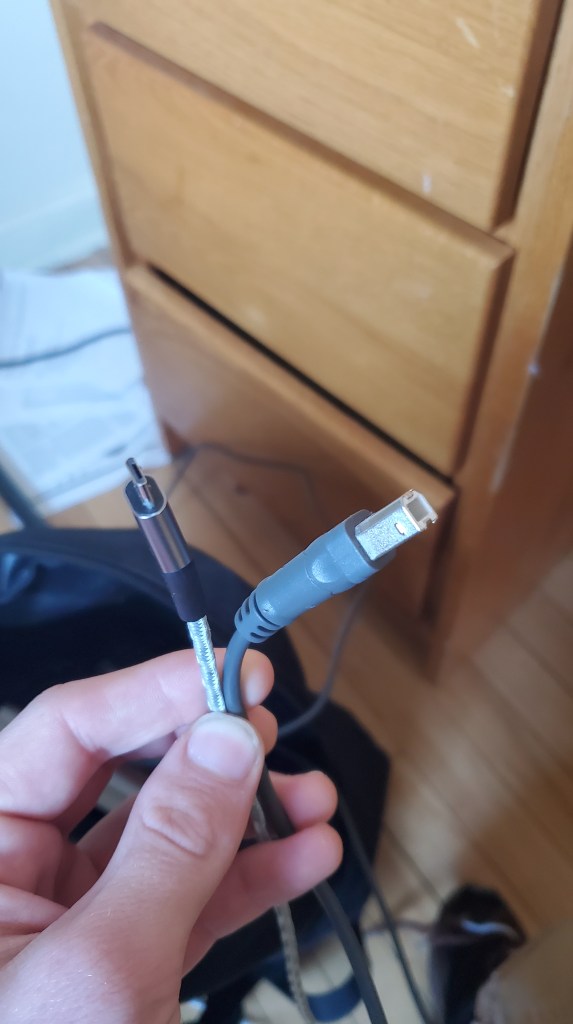
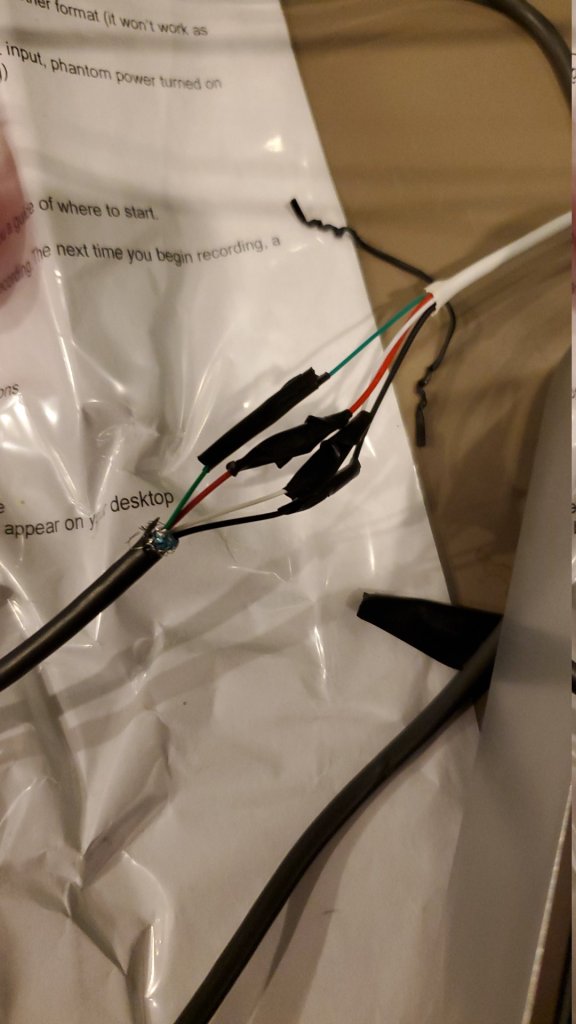
This did require, however, dishing out some money and ordering some items online. A couple things came in the mail this weekend from Catskull Electronics, earlier than expected: the teensyboy, a link cable for the GBA, and two basic Gameboy 32k cartridges- mGB and Shitwave. The Teensyboy is a tiny (teensy) device with a mini-USB jack on one end and a Gameboy link port on the other that is used to allow MIDI data to be sent and received from the Gameboy to a controller or DAW or your liking. The mGB cartridge is used to with the Teensyboy to make it work, and Shitwave is just a neat little novelty ROM that I picked up for drone/noise stuff (and it makes your Gameboy seem broken). The teensyboy is where I started having issues. I wanted to to plug my MIDI keyboard directly into the device, but my keyboard has a USB type A output and the teensyboy has a mini-USB. I don’t have such a chord; no one does. This ended up being beyond frustrating. I looked into a female to female USB adapter, which you can find for very cheap online. However, my impatience got the best of me and I decided on the rational option of cutting open the two USB cables I needed and combined the heads (USB-A and mini-USB). I did this professionally by twisting the wires together, wrapping them in electrical tape, and hoping they wouldn’t come apart.

This actually almost worked, as in the teensyboy reacted and acknowledged it was receiving power. However, despite all my efforts, I was not able to actually get the MIDI data to find its way to the GBA to produce any sound. The only way I was able to get mGB to work was by plugging it into the computer and sending MIDI from Reaper. This is helpful though: this way I can actually compose entire songs via MIDI and have it played directly on the Gameboy without much issue. However, I’d like to take any DAWs out of the picture, if possible. I am still working on this.

For the assignment I used much more basic approaches to composing with the Gameboy. I recorded couple different start-up sounds as well as a couple drones from Shitwave. I ended up using the default GBA start-up sound for the entirety of my etude. The start-up sound is a gesture that consists of two distinct tones: a lower strummed chord followed by a higher pitched “bling” sound. I also incorporated the sound of me physically turning the power switch on and off. Equalization (high bandpass filter), looping, and panning allowed me to create a twinkly texture that floated in the etude, and this was contrasted by punchy cuts of the switch. The etude concludes with a deep, droning texture of the opening chord, time-stretched and looped until it fades away. Although I would prefer to use my own DAWs such as FL Studio or Audacity, I’m having little to no trouble figuring out Reaper and composing this short etudes.

Listening Blog #1

This week we were assigned two listenings: I am sitting in a room (1969) by Alvin Lucier and Kits Beach Sound Walk (1996) Hildegard Westerkamp. I will start with I am sitting in a room.

This Alvin Lucier piece is a very straight-forward piece that is very clear about its very own conception. The piece consists of a performers voice, in this recording it is Lucier’s own, that recites a short piece of text explaining exactly what is happening in the piece. The voice is recorded and then gets played back to another recorder, then played and recorded again and again. This process is repeated 32 times and, by the nature of audio recording, the voice loses clarity each time. Even halfway through the piece it gets extremely difficult to decipher the original text, and eventually all that can be heard is the whistling resonant frequencies of the room itself. There are odd stutters and “irregularities” in his spoken performance, which eventually gets lost in the droning ambience the voice becomes. The booming noise was hauntingly large, like a cloud. What I found most interesting about the deconstruction, however, was the way that harmonies seemed to emerge. I found it especially powerful to think that somewhere, deep within the noise, was once a comprehensible human voice lost in audio compression.

Lucier notes on his intentions in the text itself: “as a way to smooth out any irregularities my speech might have”, however I don’t think this paints the whole picture. Lucier “smooths out the irregularities” of his voice by deconstructing it, which to me is an example of abstraction clearly brought into practice. By removing sonic clarity from the text more and more, deeper emotions are gradually revealed as resonant harmonies become introduced and the timbre becomes more alien. I see this as the ultimate demonstration of the importance of minimalism and abstract art as a whole.

Kits Beach Soundwalk is a much shorter piece in duration that was made in a very different way. The piece consists entirely of field recordings, but unlike I am sitting in a room, the recordings were extensively edited and arranged together. The piece feels more like a soundscape, and Hildegard Westerkamp narrates throughout the whole thing. She describes, or rather directs the listener’s attention to many of the sounds that the listener is hearing, such as the sound of the barnacles, cars, or trees. She even to some degree explains her own work process, such as using bandpass filters to remove the sound of the city in the background. One moment that was particularly striking to me was when the Mozart starts to play. What was striking about it was the contrast between that sound and the rest of the piece: Westerkamp places the sample in a such a way that it has such a small, singular sonic presence. This opposed to the other audio, which utterly surrounds the listener and completely fills the space it occupies. I think this is one example of a recurring theme in Kits Beach Soundwalk which is meant to reflect on the over-development of modern society, and to bring emphasis on the often overlooked natural beauties of our world.

Composition Blog #1

Hi, I am Ben and this is my first real blog post on this site. Most if not all posts here will be related to the Electro-Acoustic Music class.

This weekend, I was assigned to work with a partner to collect various sounds. I worked with Julia and we walked around campus collecting sounds of different lengths, timbres, and in different acoustic spaces. We spent a good amount of time following some crows outside in attempt to capture their “caws”. We ended up with some pretty clear recordings of the crows’ voices. We also captured droning, ambient sounds from various sources including heaters in different rooms, vents, and a running laundry machine. We also produced some shorter sounds ourselves, rather than recording only passive noises. For example, we recorded the sound of dropping a tennis ball, opening a door, and tapping on a handrail.

I also listened to the assigned pieces this weekend, which were I Am Sitting in a Room (1969) by Alvin Lucier and Kits Beach Soundwalk (1996) by Hildegard Westerkamp, but I will write more on those in the next blog post for Thursday.

Design a site like this with WordPress.com
Get started