Listening #8: Plastic Anniversary by Matmos

Matmos is a two-piece electronica project coming out of the eccentric Baltimore scene. With experience in writing albums utilizing a single sound source, their 2019 release Plastic Anniversary on Thrill Jockey Records embarks on an elaborate sonic journey using entirely the sound of plastic materials. Intensely rhythmic, colorful, and squeaky- the project sounds like a Jessica Stockholder sculpture at a dance party. Plastic Anniversary approaches musique concrete in a way which seems to draw more stylistic inspiration from modern electronica or IDM. With subject matter ranging from waste containers to drugs to silicone breast implants, in the style of great pop-art Matmos makes pointed commentary on contemporary life with less taste and precision but with added emphasis on accessibility and imaginative setting.

“Silicone Gel Implant” creates a rhythmic setting of lots of jumping, turning, and moving pieces mechanically working together like in a factory made of plastic. The lead that opens the track transforms into a sizzling pad with whining chords that squeak above it. I’m most struck by the second half of this track which introduces these very dark, buzzy sounds that almost reminds me of plucked sheets of plastic. Throughout the piece, sloshy, watery groans appear and disappear in the background just to fill the soundscape in unexpected ways.

Another track that particularly caught my attention was “Thermoplastic Riot Shield”. Naturally, the title of the track leads me to believe the main sample source of this piece was an actual riot shield, although it is not easy to tell from listening to it. First of all, this proceeds to show the incredible variety of Matmos’ bizarre plastic collection on this album. Secondly, the style of this piece was noticeably distinct to me. Without totally sacrificing the wacky and playful aesthetic of the rest of the album, “Thermoplastic Riot Shield” has a berserk, aggressive, almost rave-like sound. This shift in mood reflects the more dangerous context in which a riot shield would be used.

Matmos manages to use wildly creative sound sources that are buzzy, tinny, or squeaky with such expertise that it rarely ever sound abrasive at all. Sure, while the album may be “weird” or even a little unsettling, the attitude of the music regarding it’s own subject matter seems less critical and more imaginative and playful. I’m led to believe that the goal of Matmos was more to describe the nature of plastic as accurately as possible- which involved the usage of plastic in the creation of the piece, bright and colorful orchestration, and a playful (or perhaps even commercial) attitude towards its own conception. Above all: synthetic, perfectly inhuman.
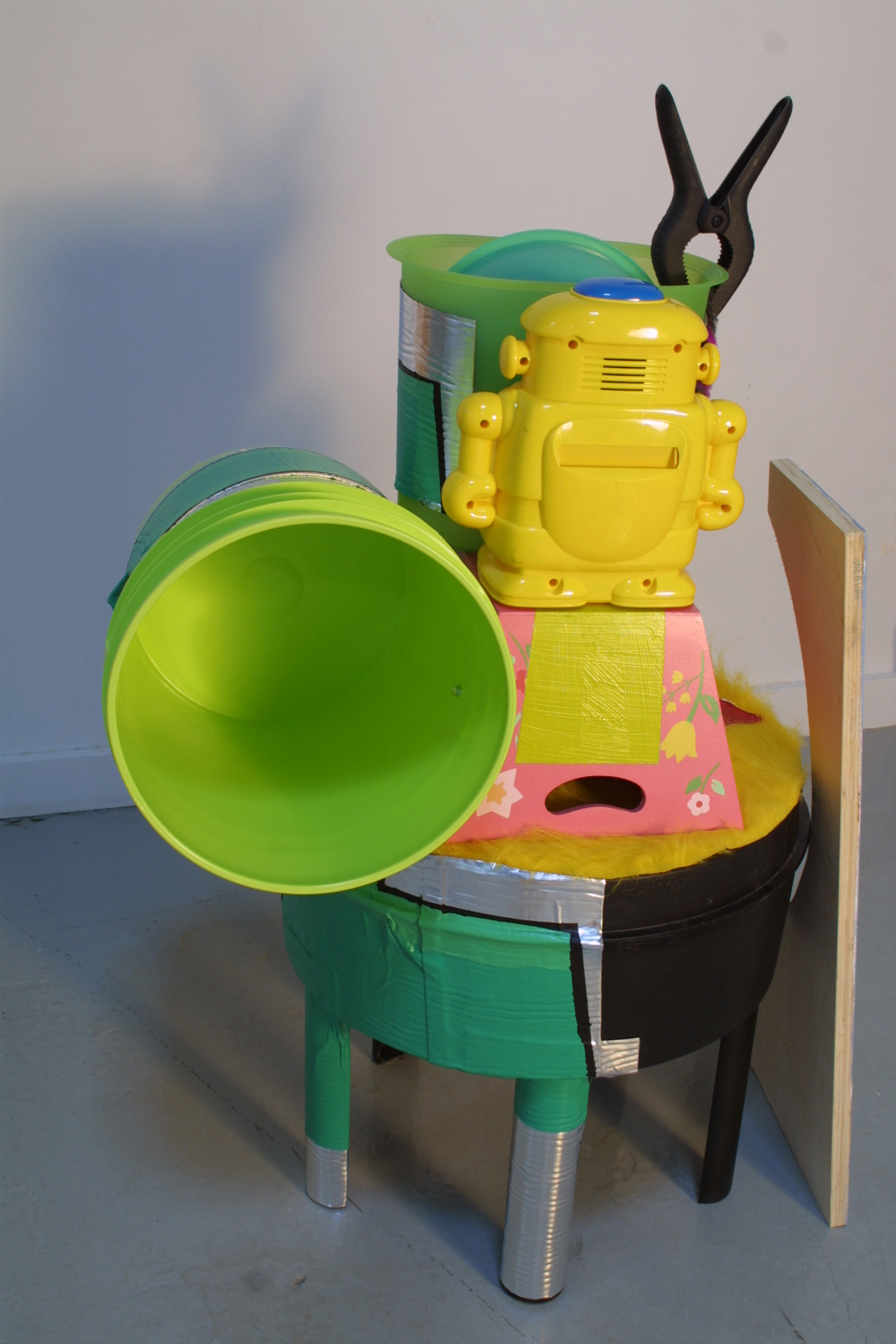
Jessica Stockholder, Tabletop Sculptures

https://musicblogben.tumblr.com/

Composition Blog #8

Three etudes: the first using a the cuckoo-clock sound which was so popular. The second uses two different recordings I made of some related (but different) chords on acoustic guitar. Sorry if this was cheating, I wanted to do something different. And the third is a drone made from the sound of a wind chime.

Finally, just for fun, I quickly showcase a cute little free VST I found called MeowSynth. I think the cat-lovers of the class may enjoy it :3

Listening Blog #7: Helena Gough’s Mikroklimata

Helena Gough’s Mikroklimata is a four-track album spanning over 30 minutes of music. A rather consistent sonic aesthetic is present throughout the album, consisting of dark, buzzy drones interrupted by sharp, glitchy sounds. It creates such a vivid setting to me, like a distopian cyber-punk city devoid of life or some kind of malfunctioning electronics. Immediately with the first track, “Tephra”, I was entranced by the sudden transitional passages that would explode or collapse the previous sonic space into a new one. Even the drones, the sound between glitches, may be quiet but have so much weight. It is rarely a single sound source but rather layered stereo-separated noises that create dissonant textures. These drones are feel unstable like they are ready to burst at any second. The “bursts” are aggressive and dense, creating such a striking contrast while still remaining dark and unholy.

At times, however, the tracks become less aggressive but much more intimate. On the closing track, “Protonema”, there is a soundscape of hundreds of tiny, squishy creatures. It even reminded me of a dark, synthetic version of Westerkamp’s barnacles sucking and tickling the mix. It made me think the setting Helena Gough is creating is like taking the listener inside some electronics, and showcasing the digital world of all the synthetic “organisms” inhabiting it.

Composition Blog #6

Here’s a quick(ish) video of a potential visual for me piece this semester (it took forever to upload, sorry for the delay). The music is Sketch for Winter VII – Abyss: For Cello by Louise Bock from Madison Wisconsin. Highly recommended for earilly still days. I just used Google Drive this time, so let me know if there’s difficulties accessing it. Thanks!

https://drive.google.com/open?id=1ZHG6xVksDAO_E7z_0skmFyMsmpB2gzLS

Listening #6: Space, Motion, and Paul Lansky’s “Ride”

Living in a small town right on Interstate 95, it’s not hard to identify Lansky’s influence with this piece. Although the sound of the travelling vehicles may come as an annoyance to many in the town, I have often been fascinated by the way they reverberate and stretch across the corn fields. The wispy sound imitates the wind, but like it’s been reflected and multiplied, as though it’s gone through a chorus filter or something. What results is less of the sound of the vehicle itself, but rather a ghost of it: a brief, stationary capture of a moving object that came, past, and gone.

These kinds of sounds are the star of the show in Paul Lansky’s Ride: a twenty-minute electro-acoustic piece transforming traffic into spacious chords and ambiance. These chords swell and decay throughout the piece but it’s hard to find the space between the notes, every tone sounds somehow bled into the next to create one super-tone. Whispers slide across one ear to the other, like a passing vehicle. Although these sounds literally depict motion, it doesn’t necessarily feel like the piece is quickly moving, at least not in a traditional sense with musical phrases. And yet, somehow, I found myself as a listener constantly feeling as though I’ve arrived in a new place. It is like sitting in a moving car, watching other objects pass by. You do not feel like you are moving, but rather the world around you is moving swiftly past. And yet, by the end of the journey, you have transported to a new physical space.

This ambiguous sense of motion is dreamlike: I find myself in different places but it’s usually hard for me to place how I got there. The voices that appear in two different instances in the piece really emphasize this feeling. There are many voices, all saying something, but none of them are speaking to you, the listener. Rather, it’s merely as though the listener is passing by the speaking voices, uninterested in what they might be saying. The second instance is a little different: the voices have been completely transformed into instruments. Two different groups of voices can be heard, separated by stereo placement: one that is pitch and time shifted beyond intelligible words, and the other group speaking unison “shots”, like single letters, to create some confusing rhythmic intensity. The piece ends with what sounds like the clean, raw recordings of vehicles in passing, finally confirming the source of those dreamlike, spacious sounds.

musicblogben.tumblr.com

Listening Blog #5: Concert!

For anyone interested, you can find a more in-depth post about my own piece on my Tumblr music blog: musicblogben.tumblr.com

So, at last, our group’s Planetarium-Electro-Acoustic-Extravaganza was cancelled. But the music lived on! I downloaded all the files far past my bedtime last night and listened to them beginning to end from the comfort of my room. I couldn’t quite see the stars through my window, but I could watch the lights from the occasional car or truck as they drove past I-90.

Although it was unfortunate that we could not experience the piece surrounded by each other and friends, it created a uniquely intimate relationship to the music, I thought. I could really hone into the music itself as opposed to the social space around me, and I found myself still able to identify each composers artistic identities in their pieces. There’s so much I want to say to each and every composer and talk about their pieces, but I don’t want to get into each individual piece here and I would rather tell the composers my thoughts directly first before sharing publicly. Suffice it to say that each piece well represented each composer’s musical background and presented different musical intents. Some more linearly told a story only using a small handful of sounds, stretched and morphed in lots of ways, and other were densely packed with all sorts of samples in an anxiety-provoking fever dream.

Listening Blog #4: Michel Chion’s “Requiem”

This week’s listening was of Michel Chion’s Requiem (1973). The piece contains ten movements, which are represented as individual tracks on the CD. Chion seems to divide the 10 movements into two larger parts, I (1-6) and II (7-10). Without diving too deeply into the aesthetics of the sounds just yet, it can broadly be described as a continuation of the musique concréte style with a much darker hue: tightly arranged abrasive sounds, both recognizable and not, abruptly interrupting each other throughout the piece.

Requiem can be difficult to grasp, but it is made easier to approach after reading the liner notes given in the CD. Not differently from traditional requiems, the text of the piece is based on the Funeral Mass, presented in its original language. Rather than focusing on the dead, Chion chooses to concern the piece with the “troubled minority of the living”. The most interesting piece of information I was able to gather from the notes, however, was that the piece was meant to be written “symmetrically”. Meaning, the tenth track used elements of the first, the ninth using elements of the second, and so on- with the sixth movement being the axis in the middle. This did not fully make sense to me at first for two reasons: there cannot be a middle if there is an even number of tracks, and the third movement did not seem to have anything necessarily to do with the eighth movement. I came to the conclusion that both movements 2 and 3 were related to the ninth track, as they featured the same eerie chime-like sound. This made sense, then, with movements 4 and 8, and more or less with 5 and 7 (it was much harder to hear the similarities between these two). This is all suspicion though, as Chion does not go into the specifics in how the tracks are built off of each other.

Although I did not catch onto this framework upon my initial listening, there were elements of it which I noticed. For example, I noticed by the ninth track I was hearing sounds that I had definitely heard prior. Most importantly, I found the sixth movement, “Évangile”, to be very significant and even climactic. This does reflect Chion’s attempt, as it was made to the axis of the entire piece. To me, this piece is sonically the most “unhinged”. The main dissonance that “drones” through the beginning of the movement is very bendy and unstable, like the tape is falling apart. Later, light sounds of birds can be heard before they are abruptly interrupted by another harsh sound, almost as if it exists from a different realm and is bursting through the tape. It gives the impression that the listener is experiencing something surreal or perhaps super-real.

The entire piece, to me, is meant to reflect the lifespan of a human soul, or the lifespan of all human lives in a steady flow of time. The harsh, confusing, and abrupt sounds that keep appearing and disappearing reflect the constant repetition of birth and death, and the difficulty distinguishing the two. The symmetry of the piece reflects this symmetry of a lifespan: the infinity of beginnings and ends. Hence why Chion describes “Évangile” as a “symbolic rupture of the tape…, that opens a gap of eternity in the flow of time, allowing a glimpse of ‘something else’.” But what is that “something else”? Perhaps it is the infinite, the meaning behind the constant struggle between living and dead. Perhaps it is the raw language of art and music that outlives humanity. I don’t know, I’m not a philosopher. But that sixth movement definitely caught my attention, and that ought to count for something.

Design a site like this with WordPress.com
Get started