Vertigo film score – spiraling obsession and multiple identities

Alfred Hitchcock’s Vertigo (1958) is a very mysterious movie about a retired detective with acrophobia who is given a final job to track down an old friend’s wife, Madeline, whom he believes to be possessed by her dead ancestor Carlotta Valdez. Most of the movie involves Scottie, the detective, following around Madeline before he ends up saving her and falling in love. Eventually, Madeline ends up throwing herself off a church to her demise, and Scottie spirals into a trauma-induced obsession with the woman he loved. Turns out, she is alive but she was an actor named Judy. Scottie finds Judy and tries re-incarnating Madeline through her. The vertigo that Scottie experiences due to his fear of heights is also a symbol for his love obsession with this woman that was more a deception than a real person. Judy, Madeline, and Carlotta are all characters who are blended together into the same person in a lot of ways and the music in the film highlights that with a confusing, spiraling, and leitmotif-based score.

The very first music that is heard in the film is also one of the major themes, and that is what I will call the “Vertigo theme” or the spiraling theme. Visually, the spiral motif makes several appearances. Right away in the film, there are abstract light-trail graphics that spiral into the screen as it is showing the opening credits. Spirals are emphasized in the flowers and in Madeline’s hair bun, portraying her supposed obsession with the elusive Carlotta Valdez. At 1:16:00 of the movie, the staircase that John is climbing is shot from a bird’s eye view where Hitchcock implements the famous dolly zoom or Vertigo zoom, which also represents a spiral. This spiral is directly correlated with the vertigo he is experiencing from the heights. Finally, there are many spirals during the surrealist scene during Scottie’s dream where he is suffering from the guilt and trauma of seeing the person who was his contract and his lover die. The musical theme is most often heard with a flute and a harp arpeggiating an augmented chord in quarter note triplets, ascending and descending. Both parts are playing augmented chords in the same rhythm but they are playing different chords in contrary motion. The contrasting up and down pattern and the polytonality creates confusion for the listener, as if they are experiencing the vertigo that Scottie might feel from his acrophobia. Furthermore, the way that augmented triads have tones of equal intervals lends itself to a cyclical pattern when they are arpeggiated as they are in this theme, creating a sense of spirals. The “spiraling” is a narrative theme as well. John spends the first half of the movie or so constantly following Madeline around the city, the same places again and again. With Judy, he is suffering from obsession for the woman who died in his mind and is constantly circled back with trying to reinvent her through Judy. John begins to fall apart, and the charming version of his character that the audience saw in the beginning of the film beings to fade.

Kim Novak perhaps has the most challenging role in the movie, having to play the part of two or debatably three characters at once: Judy, Madeline, and the restless image of Carlotta Valdez. Because there are different characters with just one person, having unique leitmotifs to identify (or obscure) the different characters is very effective. When she is first introduced at the restaurant, the score presents Madeline’s theme. It is song-like, sentimental, and full of sighing gestures with suspensions in the melody that suggest Scottie’s longing right away. The theme is repeated at various points, such as when our detective follows her into the boutique. The next time the viewer sees Madeline, we don’t get Madeline’s theme but a new musical idea. Over a harp ostinato, curious chromatic chords are played as Madeline appears to be entranced by a portrait of Carlotta, whom the identify of is mostly unknown to the viewer at this point in the movie. All we know is that Madeline seems to be “possessed,” either literally or figuratively, by this figure known as Carlotta Valdez who has her own theme. A theme for the character that doesn’t really exist takes the role of casting the uncanny spell that she is somehow being summoned into reality. Furthermore, the unending ostinato that underlines it is reflective of John’s repetitive quest at following Madeline around. At about 53 minutes into the film, the themes are somewhat combined with an ostinato played by the strings under what could be a variation of Madeline’s theme as Scottie is following Madeline back to his place. This occurs after Scottie has learned more about the mysterious past of Carlotta Valdez, and this part of the score may be used to represent the blurring between the two people in Scottie’s head and his growing doubt that her strange behavior is mere coincidence.

Later in the film, Scottie loses Madeline and begins seeing Judy. When he first lays eyes on her (after Madeline’s death), she is introduced with part of Madeline’s theme to tell the viewer what Scottie is thinking about. However, after we learn who she is and her backstory through the internal monologue in the letter, at about 1:42:00 there is a new theme which is Judy’s theme. This is the true Judy, separated from the role of Madeline or the draw of Carlotta. As John is trying to alter her appearance to look like the Madeline he fell in love with we hear pieces of Madeline’s theme, until finally at 1:55:00 the fully transformed Madeline enters the frame and the theme plays in full, with complete orchestration. The score here is changing the character Judy into Madeline, but then it takes it a step further at confusing the character once her and John kiss. As the camera rotates around the couple, the score has a sudden transition to Judy’s theme as Scottie has a puzzled look on his face, continuing to blur the lines between the characters and express John’s internal dilemma with the competing identities.

Vertigo is not an easy film, but it is very interesting to analyze. As it turns out, Bernard Herrmann’s score is a gold mine for a film or music student to study the ways in which leitmotifs can not only be used as a way to highlight characters but also as way to intentionally confuse identities. Confusion, deception, and obsession are the best words to describe this film- from the narrative, to the characters, to the visuals, and of course, to the score.
Juxtaposition of identities in BlacKkKlansman (2018)

Spike Lee’s BlacKkKlansman (2018) is a movie about undercover detectives investigating the Ku Klux Klan “organization” in Colorado Springs. The investigation is led by the first African-American police officer in the Colorado Springs Police Department, Ron Stallworth, in which he impersonates a racist white man to infiltrate the Klan’s trust and has a body double, Flip Zimmerman, who plays as the “white” Ron Stallworth. Despite being white, Flip is a victim of discrimination from the KKK as well because of his Jewish heritage. This dual-characterization of Ron Stallworth is reflected in the score by jazz composer and trumpeter Terence Blanchard.

My interest was caught by the music right away in the movie when it begins with film based on the Civil War. Right away we are introduced to loud military-like marching snare drum. What follows is sappy orchestral music as the picture is showing hundreds of injured or dead bodies from the war. The music is supposed to create sympathy for the Confederate soldiers who died, as the scene transitions to Alec Baldwin playing some kind of political figure speaking anti-Semitic and pro-segregationist speech over footage that depicts stereotyping or mistreatment of Black people in America. The sentimental and very “patriotic” strings are still playing over this whole speech, but it sounds cheesy and fake. It is asympathetic to the viewers’ feelings of the situation, which is hateful. However, it shows how the propaganda is made and how discrimination has been portrayed as a “patriotic” act in American consciousness. These strings represent the white, conservative identity throughout the movie.

About six minutes into this segment, it cross-cuts to establishing shots of Colorado, the setting of this movie. When John David Washington’s character Ron Stallworth enters the frame, the piece cues the electric guitar. The guitar plays the soulful, moody theme we hear throughout the whole movie. It plays over the strings we heard before, and the guitar represents Ron Stallworth’s blackness. This textural combination foreshadows a major theme: Ron Stallworth has to be two people at once. One is the racist, white KKK member and one is the black man who is sympathetic to the Black community’s struggle.

Overall, I think that Terrance Blanchard did a remarkable job at tackling a sophisticated issue between race in a stylistic and tasteful way. Not to mention, that guitar riff has to be one of the coldest movie themes ever… it’s just too cool. The movie as a whole succeeded in being greatly entertaining and extremely nuanced as well. I hope for it to be remembered as among Spike Lee’s best.

Fantastic Mr. Fox (2009) – a little… “different”

One of my personal favorite movies. Wes Anderson’s Fantastic Mr. Fox (2009) is a gorgeous stop-motion picture based on Roald Daul’s children’s novel about a Fox who can’t help but do what he does best: be sly, cunning, and wild. The story pulls at the heartstrings of the viewer with characters that can be sympathized for their relatable family dynamic but is held back by Fox’s constant need to impress and be “fantastic”. Fox meddles with the three most infamous farmers in the country: Boggis, Bunce, and Bean, who go on a tireless quest to get revenge on Fox and end up endangering all the other animals in the process.

There are a couple recurring themes and leitmotifs in this movie. The most obvious one is the theme for the three farmers. The theme is first introduced about 7 minutes into the movie, before Fox nor the audience even know who Boggis, Bunce, and Bean are. Only when Fox meets with his financial adviser is he given the whole scoop- and with it, we are given the origin of the music itself which is supposedly derived from a children’s song in the movie. Now that there are words to a theme the audience has already heard, the theme has added value by text. This theme is used constantly throughout the movie but it may be used in different contexts for different characters. For instance, Rat has his own variation of the theme that is whistled and is accompanied by Spanish-flavoured guitar work to give him his characteristic flair while still showing that he is working for Bean (or at least he thinks he is).

The other theme I particularly noticed during this viewing of the movie is one that is heard during multiple moments of connection, understanding, or sacrifice within the Fox family. It is in a major key and consists of a banjo ostinato that is joined by a xylophone. These timbres, in my opinion, give such a heartwarming “children’s book” emotion which is appropriate considering the text that the movie is based on, and also the way the movie deals directly with family-related issues. An example of when this music can be heard is when Mrs. Fox is giving Ash a talk about “[knowing] what it’s like to feel… different“. In this clip there’s no mallets, but the melodu is traded-off with another banjo and a flute. Both of these give a children’s song pastel aesthetic.

Ash will always be my favorite character

Finally, there are a couple uses of cultural references in the movie. The Beach Boys make multiple appearances in the movie: the first is during Foxy and Felicity’s last farm heist before they decide to hang up the criminal life (or at least, for the time). The song, “Heroes and Villians” is a classic ‘getaway’ soundtrack trope that has some ironic value when used with foxes behaving like humans. The music comes to an abrupt stop when Fox traps himself and his wife under the cage and they are seemingly doomed. Once Felicity drops the bomb that she is pregnant as well, Mr. Fox gives an exaggerated smile in the reaction shot to try and hide his shock. To add to the humor of the situation, the song kicks back in during this reaction shot which is adding to the chaos of the situation and is sort of helping Foxy to hide his panic.

There are just so many good things about this movie. The visuals, the writing, the casting… so I’m really glad to watch the movie again with music in mind for me to realize that the sound is just another part of the genius of the film. I had no doubts.

Emma (1996)

Gwyneth Paltrow’s breakout role, Emma (1996) is a period piece by Douglas McGrath set in Victorian-era England. The movie is about Emma Woodhouse who is stubbornly against getting married and so motivated to find a suitor for her best friend Harriet, but she ends up finding her own love instead.

The music in Emma is composed by British composer Rachel Portman. She is clearly very well classically trained as the entire score fits nicely into a Romantic style which not only reflects the mood of the movie but obviously the time period as well. As a period piece, it makes sense: it would have been inappropriate to have Baroque-style music just as it would be to have modern contemporary styles of music in the film. It is important that this distinction is made not only in the instruments used but in the style of composing for the viewer to be properly immersed into Emma’s world. What is heard in the main theme of the film is delicate song-like melodies and lots of quaint clarinet or other woodwind melodies that accompany Emma through her journey. There are a couple of instances of diegetic sound in this movie, such as the scene where Emma plays piano and sings for an audience of party attendants. While I don’t know the particular song, I am sure it is appropriate for the period and Portman does a good job making the original, non-diegetic music match in style with that piece.

The main theme of the film, which is introduced right away at the beginning of the movie, is constantly repeated throughout the film in different ways that are fitting. For example, about 25 minutes into the film the theme can be heard with sleigh bells added when the characters are going to the Christmas Even party. After that party, when Emma must refuse Elton’s marriage proposal and realizes that she had read him wrong the whole time, the theme returns in a darker, minor key. The accents are heavier, there is added brass making it more “stompy”. About another 50 minutes after that, when Emma realizes that she has wronged Miss Bates and Mr. Knightley scolds her, there is a very sorrowful and wistful variation of the theme that is slower and more prominent in the strings.

Overall, Emma (1996) may be a more down-to-earth story that’s not about aliens or murder mysteries but, much like Laura (1944), the music does a fine job pronouncing the time and setting of the film with a clever and diverse use of a single theme.

The soundtrack to authenticity in Pee-Wee’s Big Adventure (1985)

Tim Burton’s first feature film Pee-Wee’s Big Adventure (1985) is about… well, Pee-Wee Herman. A bubbly, silly, child-like man of whom the viewer knows nothing about in terms of residence, occupation, family- all we know is his whimsical personality and that he really really likes his bike. And then his bike gets stolen, and then he tries to find it across the country, and that’s Pee-Wee in a nutshell. But somehow, it barely scratches the surface. Although one may not consider this film to be particularly emotionally “heavy,” every expression and emotion experienced in Pee-Wee’s adventure is huge and amplified by the acting and Daniel Elfman’s characteristic soundtrack.

At about 12 minutes into the film, we get Pee-Wee’s first biking sequence (besides the Tour de France dream in the beginning). Right away, the music is giving the viewer a window into Pee-Wee’s unpredictable mind as he sings the first few notes of this theme, synced up with the score. This confuses the audience and makes the viewer wonder if the sound is diagetic or not, and will keep them listening for any more details like that. This theme is very march-like but is different from the main theme. When Pee-Wee lifts his wheels up to try and do a wheelie, the upper strings time the action perfectly and we hear little lifts on both attempts. What makes this funny is that Pee-Wee doesn’t really succeed at doing a wheelie, at least not like the kids he’s trying to imitate, but the music amplifies it with flair anyway. This is just one of the many examples in which Pee-Wee acts silly, strange, or childlike but the music plays as though it’s on his side, rooting him on. The music could have portrayed his character as stupid or pathetic when he fails at something or says something that might get him in trouble. But instead, the music is always on his side, has the same “larger-than-life” attitude, and is always feeling what he’s feeling.

At about 20 minutes into the movie, the first major plot point occurs: Pee-Wee Herman’s bike is gone. At this moment, there are repeated down-beat chords high in the upper strings that, to me, echoed the iconic horror scene in Alfred Hitchcock’s Psycho (1960). Referenceing the music of a well-known murder scene in cinema, Tim Burton and Daniel Elfman create irony because Pee-Wee just lost his bike. At the same time, however, the audience knows that his bike meant absolutely everything to him and the music reflects that. This is another instance in which the music is used to reflect exactly what Pee-Wee is feeling even if it may seem exaggerated or silly to the audience.

Pee-Wee’s Big Adventure is a fun, playful film but Tim Burton demonstrates right away with his legendary career that he takes playfulness seriously. Because underneath the guise of a “children’s movie”, Pee-Wee is actually a very original and bold film that finds the magic in pointlessness.

Close Encounters with the Third Kind (1977)

Steven Spielberg’s Close Encounters with the Third Kind (1977) is a film about unidentified spacecrafts making an appearance on Earth, but instead of a suspense-filled invasion like most alien movies, it’s more mysterious and alluring. Although the movie does have its thrills, the reaction of the audience is more often wonder, shock, or awe rather than fright. The way that the scientists in the movie learn to communicate with the extraterrestrials is with music: a five-note melody that was broadcasted as radio frequencies into space and directly to the aliens with a massive speaker system at the end of the movie.

When discussing music in this film, the most obvious subject would be the way this very melody is used. The solfege syllables are transcribed directly in the text of the film: re-me-doe-(octave) doe-so. This very simple, diatonic melody can be heard in numerous places throughout the film, both diegetic and not. For instance, the young boy Barry plays the tune on his toy xylophone, and it is used prominently as a theme in the movie’s score. Especially noticeable at the end of the movie when the mothership is flying away, the melody is nearly impossible to miss in the strings. However, the spaceship played much more than this melody in response to the humans. For the “third kind’s” grandest statement, or perhaps teaching the humans their language, the ship starts by playing rapid variations of the theme with an instrument that sounds (suspiciously) like a tuba, and some responses that are almost like a flute or oboe. This “performance” was almost fugue-like, and ends up incorporating many more instruments that resemble other brass and woodwind instruments. Despite being very chromatic, it seems to follow conventions of what oddly resembles Western classical music.

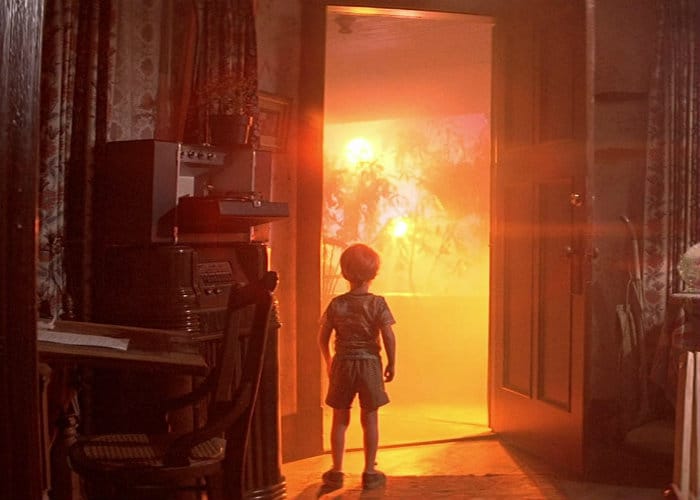
A scene that really struck me, although didn’t feature much music, was about 15 minutes into the film when Barry first encounters the extraterrestrials in his house. After all the sounds of the bleeps and running motors of his toys which are coming alive, he walks downstairs and there is the sound of something wandering the house. Footsteps, things falling over, and doors opening are all heard while the camera stubbornly shows only a medium shot of Barry’s reaction. By obscuring what is making those noises, the viewer is left only to wonder, which heightens the viewers’ interest and creates a dramatic tension between the character and the fourth wall. Furthermore, it is symbolic of the fact that throughout the movie Barry seemingly knows more about who or what they are than any of the other characters in the film. He knows things that the others don’t and that is demonstrated in this scene where we are given only his reaction to the events that are unfolding in his house.

In all honesty, it’s hard to pick only a couple moments of this film to discuss in regards to the sound and music. John Williams definitely leaves an impression with his ability to compose memorable themes and highlight the curiosity and wonder that films have the ability to cast on a viewer. Before this film, my mind typically went to Star Wars or Indiana Jones when I thought about John Williams’ music, however now I can see that Close Encounters is overlooked. Beyond just the music, all the sound work in the movie is nothing short of incredible and truly leaves the viewer with a bigger-than-life sense or wonder.

J.J. Abrams may have gotten some inspiration from the lighting in this movie…

Sound and Music in In The Heat of the Night (1967)

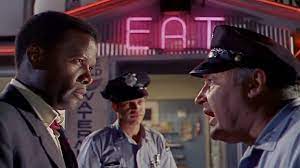
Norman Jewison’s In the Heat of the Night (1967) is a mystery drama that unravels a gripping murder case while candidly dealing with topical racial and social issues in America. The story takes place in the small town of Sparta, Mississippi which had plans for a prosperous factory to be built until the owner was found dead from a homicide. What was originally assumed by the local police to be a simple robbery-murder case was found to be the result of racial tension by Virgil Tibbs, an African-American Philadelphia homicide expert who happened to be passing through the town at the time of the murder. The film highlights racial bias in day-to-day life and in the judicial system, and how deep-rooted biases affect our assumptions.

The main theme by Quincy Jones has lots to be enjoyed: a gospel arrangement sung by Ray Charles with a memorable refrain that sets up the rest of the movie. However, it is the more subtle ways that the theme is used later in the movie that interested me most. At around 58 minutes into the film Virgil is inspecting Colbert’s car and finds a couple of clues that lead him to believe that Colbert died in his vehicle. While doing so, there is the recurring wood block that is heard whenever Virgil seems to be suspecting something or connecting some dots. On top of that is the excellent flute work. It incorporates fluttertounge and is possibly improvised, adding some curiosity and mystery to the sparse texture. When he holds up the twig from the cotton fern there is a subtle variation of the main theme in some reed instruments, possibly clarinet and saxophone. This lets the viewer know that Virgil just figured something out.

Beyond the music, the soundwork when there’s wasn’t any score really had an impression on me. There was a very intentional use of ambient effects such as crickets which actually amplify the quiet or the squeaking of Gillespie’s air conditioner that tells the viewer how hot it is during the night. A scene that stood out with its lack of music was the chase sequence about 26 minutes into the film where the police are pursuing Harvey. Where one might expect intense music in this chase scene, there is instead only the sound of rustling leaves, dogs barking, and heavy breathing. The choice to omit music from this sequence actually adds emphasis to these sounds and creates immersion for the viewer.

Overall, the movie was very refreshing to me in its approach to sound and music. The music the movie used featured really unique textures that weren’t the typical orchestral themes and the ambient sounds really helped suspend the viewers’ disbelief that they were in the hot, southern town of Sparta, Mississippi.

Music in The Adventures of Robin Hood (1938)

The legendary Adventures of Robin Hood (1938) tells a story of heroics, excitement, and wit. Directed by Michael Curtiz and William Keighley, featuring Hollywood stars Errol Flynn and Olivia de Havilland, and with the brilliant music of the celebrated film composer Erich Wolfgang Korngold, this film was truly a cinematic phenomena in 1938 and a treasure to this day. The key swashbuckler characteristics: integrity, wit, and charm are all revealed to the listener right away with the theme that opens the very beginning of the film and will be heard throughout. This theme is a march-like melody with a frequent accented dotted eighth-note to sixteenth-note rhythmic figure that is very easy to remember and to identify. This theme makes the listener think of triumph and bold action, inviting them into the film right away. It transitions to a B section that is a little darker and more ominous, telling the listener that there is danger and trouble in this film as well, which will excite the viewer. Finally, when the prologue text appears, the music is perfectly timed to transition to a C section which is much more wistful and song-like. This C section is mostly in the strings and might make the viewer think of romance, which is appropriate because this theme is used later in the film for the Robin Hood + Lady Marian scenes.

One part of the film I found particularly engaging is during the first meeting with Prince John in his hall. The music here, around 6 or 7 minutes into the film, is very regal and proper. Although this is fitting music for characters of royal blood, it is somewhat asympathetic to the emotions of the viewer- many of these characters are soon to be introduced as antagonists. When Robin arrives to the hall during minute 10, the music takes a darker turn. This is foreshadowing the danger which is waiting for him in the castle. When a fight finally does break out somewhere 14-15 minutes into the film, we hear an intense variation of the opening theme of the movie. The arrows make exaggerated sounds when they are shot from the bow and repeatedly make a percussive “thump” sound when they are fired into many different wooden surfaces. The percussive sound of the arrows are fitting for the fast-paced music and excite the listener by making the source of danger very obvious. This section of the score keeps the audience on the edge of their seat by making a constant back-and-forth between hopeful and intense as Robin takes and loses the upper-hand in the fight. The music changes in rhythm and texture again once Robin Hood and his pursuers are on horseback. A repeated downward glissando fall in the some of the strings and flute can be heard with a percussive role supporting a fuming staccato melody in the strings. To me, this effect mimicked the galloping of the horses.

Semantic Web in This Is: Spinal Tap (1984)

From this deleted scene in This Is: Spinal Tap (1984) we are given an audio-visual gag in which musical sound is providing added value to the text for humor. Nigel starts the joke by explaining that he is writing music in the style of an “Indonesian folk tune” and presents a rather poor grasp of cross-cultural musical connections/styles. He demonstrates what people “normally” (?) play by plucking a major third, supposedly contrasted to Indonesia where they play tritones instead. So far you might be thinking that Nigel is going to make a point, but he then goes on tangent about how he is also writing in the style of “Western country music of the United States”, and demonstrates how it is actually very similar to Indonesian folk music by simply playing the same interval he played before. Part of the joke works because the viewer thinks Nigel is going to go somewhere with his connection but doesn’t really, but a key part of the joke is the semantic connection the viewer creates between that single interval and “Indonesian folk music”. By reusing the same interval for the Western folk music the semantic web by connecting the two contexts with the same musical idea is so painfully obvious (at least, based on Nigel’s demonstration) it invokes a comedic response.

Design a site like this with WordPress.com
Get started